
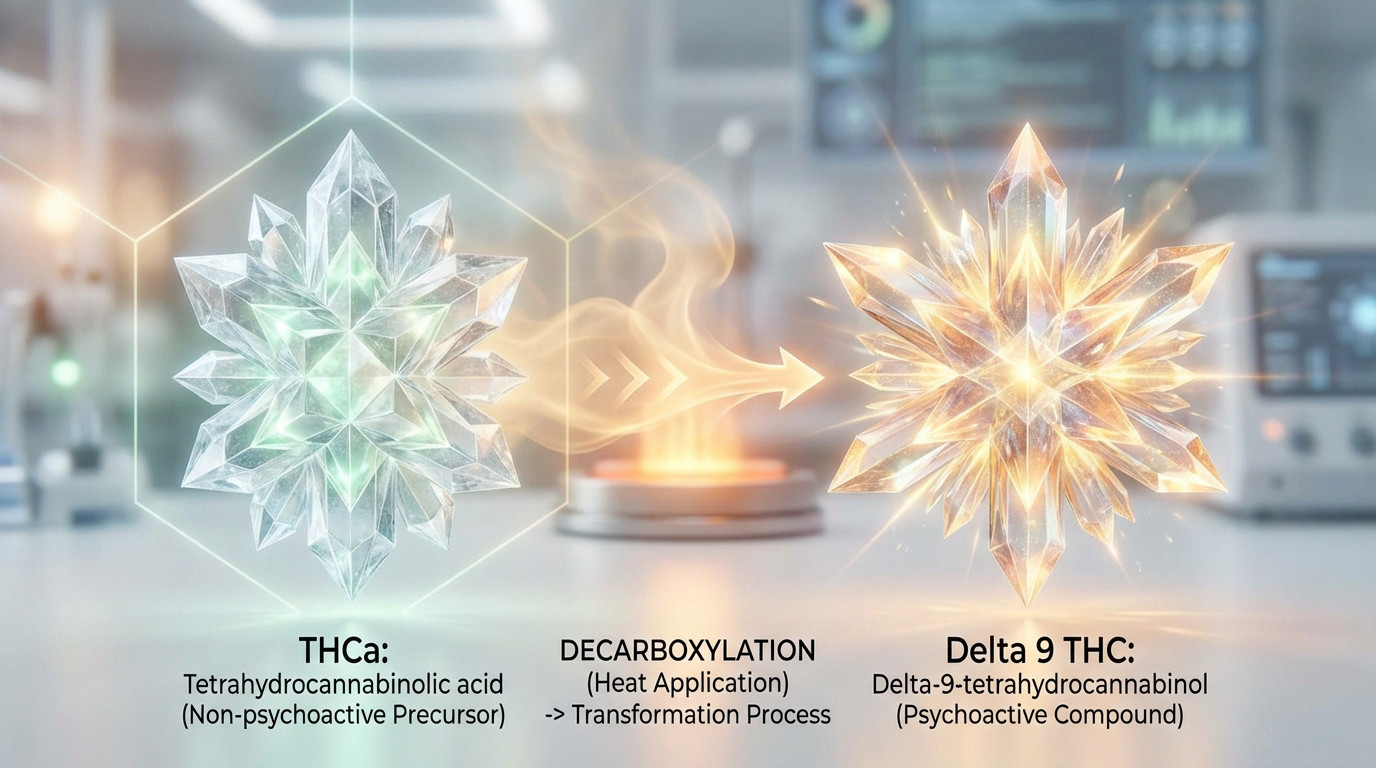
The key takeaway: THCA is the non-psychoactive precursor that converts into potent Delta 9 THC only through heat-driven decarboxylation. This process is essential to activate the psychoactive effects, meaning raw cannabis requires smoking or vaporizing to release its potential, with final potency determined by the specific conversion rate of 0.877.
Are you confused about why some legal hemp products get you high while others remain non-intoxicating? We break down the chemistry of delta 9 vs thca to reveal how a simple heat source alters both legality and effects. You will discover the specific conversion process that turns a raw loophole into a potent psychoactive experience.
- The Core Chemical Divide: Psychoactive vs. Non-Psychoactive
- From Potential to Potency: The Conversion Process
- Real-World Implications: Effects, Legality, and Safety
The Core Chemical Divide: Psychoactive vs. Non-Psychoactive
You might be missing out on the experience you actually want by ignoring this simple chemical reality. The distinction between these two compounds isn’t just academic jargon; it is the difference between feeling nothing and feeling everything. Here is exactly how the chemistry works.
THCa: The Raw, Non-Intoxicating Precursor
THCA (tetrahydrocannabinolic acid) is the natural, acidic form of THC found in raw and living cannabis. It exists before heat touches the flower. This compound remains totally non-psychoactive in its original state.
Its structure holds a specific “carboxyl group” that prevents it from binding to the CB1 receptors in your brain. This chemical shape explains the complete absence of a “high.” Consumed raw, there is absolutely no effect of intoxication.
Think of THCA as the dormant potential of THC, just sitting there. It is simply waiting for a specific transformation to finally release its full effects.
Delta 9 THC: The Activated Compound That Delivers the High
Delta 9 THC is the famous cannabinoid everyone knows for its potent psychoactive effects. This is the specific compound responsible for the euphoria you feel. It directly alters your perception and mood.
Delta 9 is simply the result of THCa that has been transformed by heat. Chemically, it has lost that restrictive carboxyl group, allowing it to fit perfectly into your brain’s CB1 receptors. This precise interaction is what triggers the psychoactive effects.
Unlike its acidic precursor, Delta 9 is immediately active the moment you consume it. It requires absolutely no further conversion to produce those characteristic effects.
From Potential to Potency: The Conversion Process
Decarboxylation: Applying Heat to Unlock the Power
Raw cannabis does not get you high. Decarboxylation changes the game by applying fire or heat. This process transforms inactive THCA into Delta 9 THC.
Heat rips the acidic carboxyl group off the molecule. This specific molecular shift is the trigger. It activates the compound’s psychoactivity within your brain.
To see exactly how this transformation alters the compound’s nature, review the comparison below which highlights the shift from raw potential to active effects.
| Feature | THCA | Delta 9 THC |
|---|---|---|
| Psychoactivity | Non-psychoactive | Psychoactive |
| Chemical Form | Acidic precursor | Activated form |
| Source | Raw/living cannabis | Heated cannabis |
| Activation | Requires heat (decarboxylation) | Active upon consumption |
Why 25% THCA Doesn’t Equal 25% THC
Most buyers assume a direct one-to-one swap. That is a costly mistake. The carboxyl group we removed has actual physical weight. When it vanishes as gas, you lose total mass.
Chemists use a rigid formula: THC equals THCA times 0.877. That is the theoretical maximum. A flower testing at 25% THCA will never yield 25% THC.
It might seem like a minor technicality to some. However, understanding this math is the only way to know the real potency of your product.
Real-World Implications: Effects, Legality, and Safety
Forget the chemistry lesson for a second. You likely care about how this hits you and if it’s going to get you in trouble. Let’s talk real effects, the law, and the traps you need to dodge.
Effects, Benefits, and Ways to Consume
Delta 9 is the heavyweight champion for pain relief, appetite stimulation, and mood enhancement. Raw THCa is the new kid on the block, showing serious promise in recent studies. It offers benefits without the high.
- Potential anecdotal benefits of raw THCa: neuroprotective support, aid for a healthy inflammatory response.
- Consumption methods: For THCa (non-psychoactive): juices, smoothies, tinctures. For Delta 9 (or heated THCa): smoking, vaping, edibles.
The Legal Loophole and Consumer Safety
Here is the loophole regarding the 2018 Farm Bill. THCa often sells legally online because it isn’t technically Delta 9 THC yet. But watch out. Heating it instantly converts it into a substance that local laws might ban.
Don’t think you can outsmart a drug test here. Consuming THCa (heated) will absolutely trigger a positive drug test for THC. Your body metabolizes it exactly like Delta 9. You risk failing if you ignore this.
Since the market is wild, stick to reliable vendors selling lab-tested THCA flowers. Unlike some Delta-9 products, quality varies heavily.
- Potential side effects of Delta 9 (or heated THCa): dry mouth, red eyes, dizziness, fatigue.
Understanding the distinction between THCA and Delta 9 THC empowers your cannabis experience. While raw THCA offers non-intoxicating potential, applying heat unlocks the potent effects of Delta 9. Whether navigating legal loopholes or seeking specific benefits, knowing how to control this conversion is essential for safe and effective consumption.